The Summer of Love
The year 1967 seems like an amazing time to have been alive - the Summer of Love, the first successful heart transplant, the first Super Bowl, and the Beatles dropping Sgt. Pepper's Lonely Heart Club Band. At least this is what ChatGPT tells me, I was negative 12 years old.
But the topic at hand is much less groovy. We went hunting through history looking for periods similar to today - periods where, despite inflation above target, unemployment under control, and the stock market doing well, the Fed decided to lower interest rates. And that's what drew us to March of 1967. At the time inflation was about 3%, unemployment was about 4%, and the stock market was at all-time highs. Sound familiar?
The chairman of the Fed at the time was William McChesney Martin - a man whose name was an enemy of brevity and whose naivete about the machinations of Washington DC is almost hard to believe. He was told by President Johnson that the administration intended to tighten fiscal conditions and he believed him. Now - hold on to your hats, because this is going to shock you - Congress did NOT reduce the fiscal deficit, and instead kept spending without commensurate tax increases. That bamboozled Martin into doing what Powell seems happy to do on his own accord, which is to lower interest rates when stocks, inflation, and unemployment argued otherwise.
The first and least surprising thing that happened was that inflation picked back up - strongly enough that before the calendar had flipped to 1968 the Fed had to reverse course and start raising rates. The episode prompted Martin to lament that the Fed had a "credibility gap" when it came to inflation, an understatement that presaged the high and volatile inflation of the 1970s. Rising inflation expectations (and growing concern about fiscal deficits - again, sound familiar?) trampled the bond market, causing yield curves to steepen and long-term interest rates to rise. A passive holding of US treasuries lost ~10% over the 12m from the day they first eased policy.
What happened in the equity market is perhaps more surprising. No asset bubble was inflated by the overly easy policy. Instead, the lesson was that inflation and an angry bond market are not to be trifled with. The equity market was flat over the next 12 months in nominal terms, which means in real terms it was firmly negative. And that trend continued. And continued. And continued. This whole debacle kicked off a 25 year period of no price appreciation in the US stock market in real terms. The US stock market didn't make an inflation-adjusted high from the time I was negative 12 years old until I was a teenager. Of course that was caused by more than one errant easing cycle, but it gives a sense for what Powell et al are flirting with.
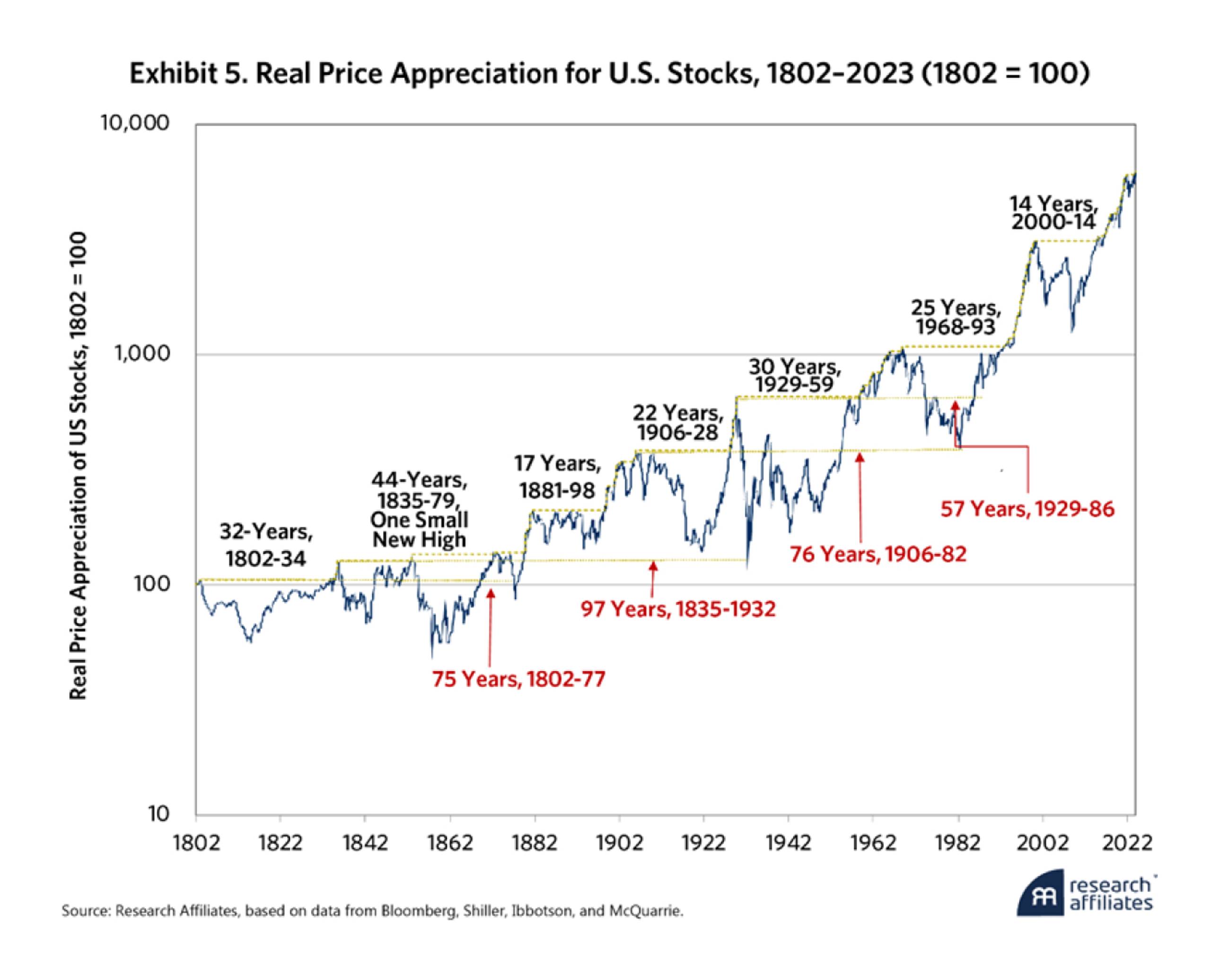
Real Price Appreciation for U.U. Stocks, 1802-2023
So the natural question is what did well? It's a hard question to answer. The investment universe was much smaller then, and the assets we most expect to do well in this type of environment didn't exist. We were still on a gold standard as a country, which meant that the price of gold was legally decreed to be stuck at $35/oz. REITs were still a baby. Financial market trading of oil didn't start until 1983. Bill Clinton was 21 years old and probably enjoying the Summer of Love way too much to give a single thought to fixed income markets and the TIPs that his administration would start issuing in 1997. So while we think this list would likely have done pretty well...we can't prove it.
We do historical exercises like this to help shape our views on the relative probabilities of different outcomes. Studying history is a good way to understand the ways in which one action can cause a second which can cause a third. These are the linkages that work behind the scenes to shape the markets. There is no guarantee that things will evolve from here like they did then. Every moment in history is a snowflake and there are obviously lots of dissimilarities between March of 1967 and September of 2025 too. Still, we think there is much to learn from this case study.