The Cavalry Isn’t Coming
The language of finance seems almost intentionally imprecise. I guess that makes sense - a lot of the discourse is making predictions about the future, which are usually wrong, so from an ego and brand management perspective it's helpful if your vernacular is vague enough that you can defensibly change what you meant after the fact. It's also helpful that many of these words are so ubiquitous - "liquidity" or "beta" or even "inflation" and "growth" - that it makes people sheepish to ask what is actually meant by them for fear of looking stupid. This gives pundits air cover to say whatever they want and reinterpret it later.
"Value" is one such imprecise word. Probably the most common usage is to mean "I think this thing will go up," which is actually a different concept. So people contort themselves to discern the "value" of things that don't have cash flows. Crypto and commodities are classic examples - bullish investors love to throw some squiggly lines on a chart showing that the gold/oil ratio or the gold/silver ratio or the gold/S&P500 ratio is out of whack and therefore something is good "value." Those charts are pure rubbish.
"Value" in investing is a much narrower concept. It means the current price is below what you get if you take the future cash flows and discount them to the present using a normal rate of return. There is nothing in the definition that makes a specific prediction about subsequent returns, though empirically you will find if you study the topic that "value" has virtually no predictive power in the short run but a pretty great track record in the long run.
Classically, the way value investing worked was a manager would find some under-the-radar company that was poorly understood by the market. They would do the analysis and decide the stock was undervalued. They would buy the stock and then yell from the mountaintops about how amazing the stock was, and other stockpickers would do their own analysis and if they agreed they would buy it too and the price would get pushed to fair value.
This isn't how things work anymore. The stockpicker cavalry doesn't exist to nearly the same degree, as it's been replaced by cheap index ETFs. So if you find a stock that is good "value," you often have to be willing to just own it and collect the outsized cash flows, instead of getting some kind of windfall when other investors notice what you noticed. Maybe you get lucky and it gets added to a big index, giving you some of that sweet passive investor honey, but you can't count on it. You need patience, more than most investors possess.
While I've given a precise definition of "value," I've glazed over the reality that calculating value is actually rife with nonsense. Here, the issue is that analysts decide what they want the output to be, and then retrofit the earnings growth rate to get them the answer they want. I would venture to guess that over 90% of Wall St. published price targets fit this bill, which is why you should aggressively ignore them. I leave you with my favorite case study of this: Tesla. If you try to value Tesla, you get nonsensical results. We ran it through our process and it spit out that by 2035, Tesla sales would have to be about ~25% of US GDP. In other words, all money in New York, California, and Texas spent by every entity on literally anything would be used to buy Tesla products. And yet...that doesn't stop Wall St from contorting themselves to make sense of the "value" of the company, instead of the common sense approach of saying "value has nothing to do with Tesla returns, the stock is just a call option on Elon Musk becoming a real-life Tony Stark."
The chart below is complicated but is also one of my all time favorites, so I'll explain it as carefully as I can. If you still are having trouble let me know and I will help you through it. The white line is the price of Tesla stock, on the left axis. It's a bumpy ride, but it goes up about 30% over this period. The colored lines are what Wall St was putting into their models for earnings per share for each future year, as of the date on the chart. So for example, the light blue line is their 2029 earnings per share estimate. In 2022, it was about $15/share. Now, it is $6.92/share. Each year follows a similar glide path down, culminating in my favorite line, 2025. In 2022, analyst models had 2025 EPS at about $7.50/share to make the price of Tesla stock make sense from a value perspective. Now we know the actual number is looking like $1.73. They missed by ~4.5x. This is what I mean when I say "value" and "I think this thing will go up" are different concepts!
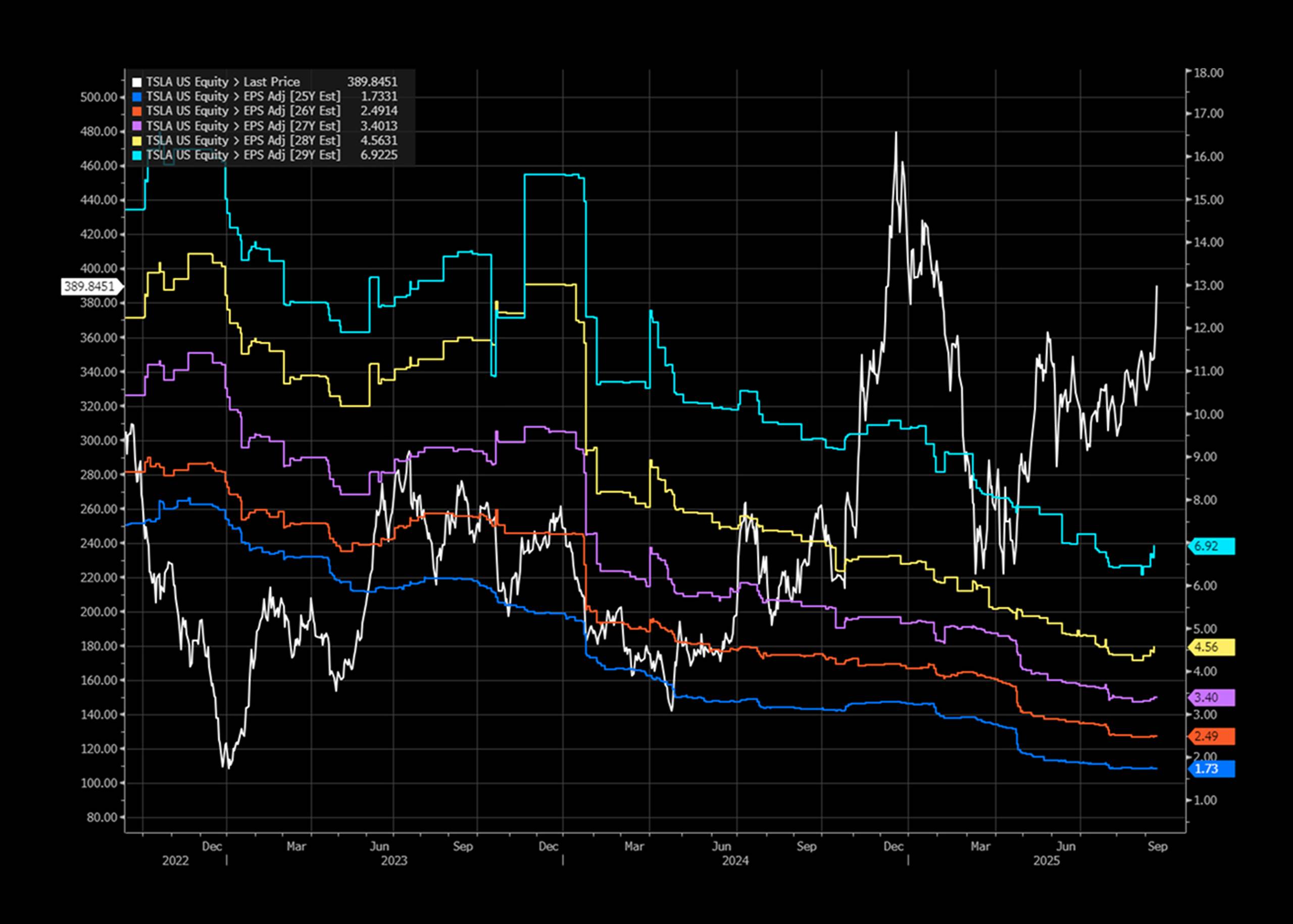
Falling Earnings Estimates vs Rising Tesla Stock
I'll finish with some quick procedural points. These notes are public, you should forward them to anyone you want. If you think someone would appreciate being added, just let me know. And if you have a topic/article/question you'd like me to write about, also let me know. I hope these notes are helpful to people, and if you have a question others probably do too. - Josh