Tax-Aware Long-Short: Meaningful Benefits, Unspoken Risks
Tax-aware long-short strategies have absolutely exploded in popularity, adding over $100bn in AUM in the last year alone. Part of what makes that so wild is that so little is said about their risks. They are treated in the financial media as if they are magic machines that make taxes disappear - and the underlying complexity is hand-waved away. What follows below is our view on some of the risks of these strategies. The tldr is that we think these strategies — sized appropriately and allocated to strong asset managers — have a beneficial role in many portfolios. But only with eyes wide open on how they can go wrong.
These managers are aiming for a portfolio of longs and shorts that are neutral to a benchmark like the S&P, with returns coming in two flavors: (1) performance above zero, and (2) realized losses used to offset gains. Like any other hedge fund, they can perform well or terribly based on the manager or market conditions, and in any given year or series of years these strategies can lose a lot more than they provide in tax benefit.
As an example, below are the drawdowns of AQR’s equity market neutral fund – what they sell as a stand-alone long-short. Its done particularly well in the last few years (not coincidentally when they have had massive success selling their tax-aware strategy). And because of that, the cumulative performance since inception is solid. But investors in the first few years experienced a 38% drawdown over the course of five years.
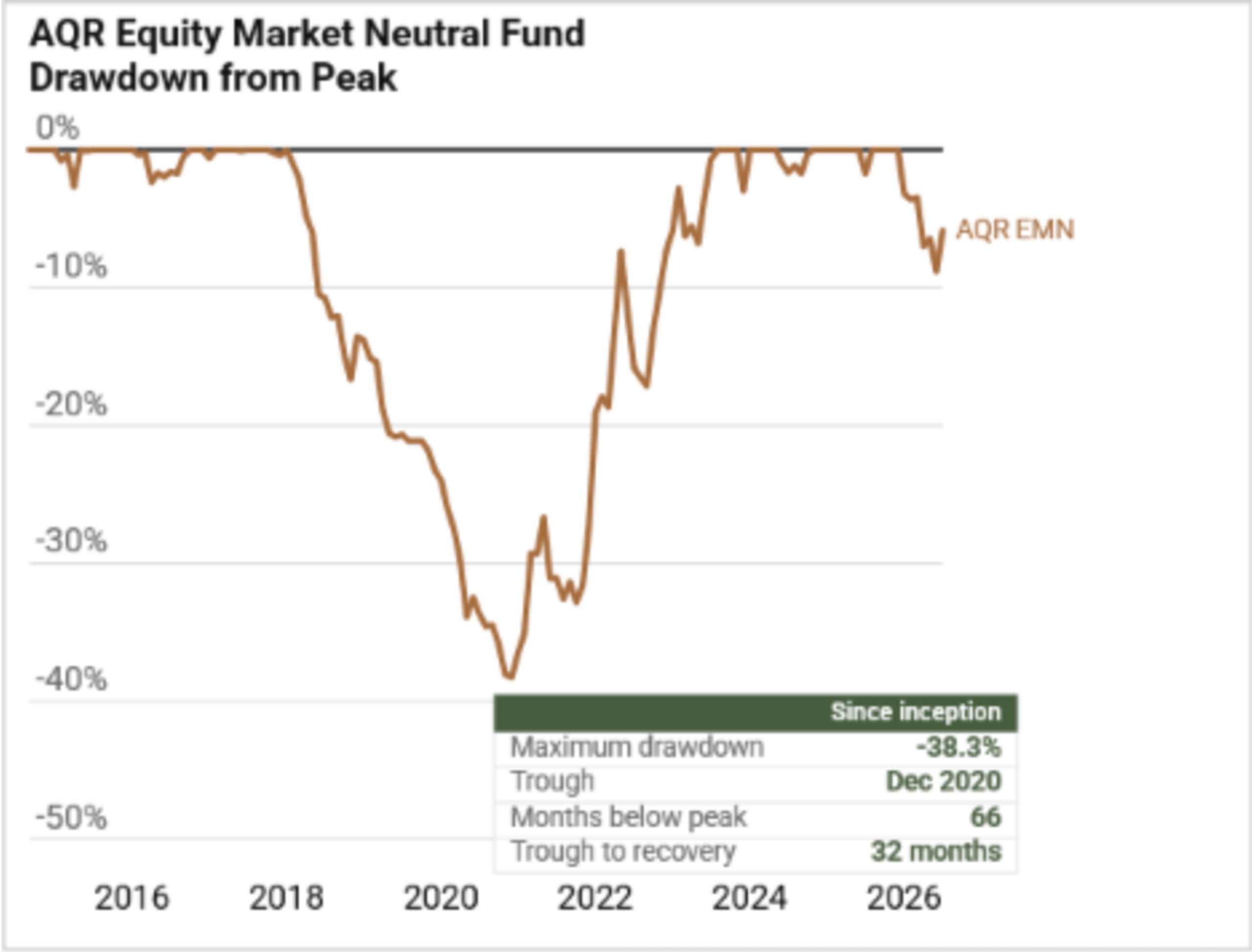
These losses are not wildly outside the norm, even for funds with a good long-term record that haven’t lost their edge. One of the hardest things about allocating to managers is knowing, on year three after they’ve lost 40%, whether they have the capability to earn it back. The history of financial markets tells us that many clients probably threw in the towel at the trough and got the bad without the good.
These strategies are also susceptible to broad market events that impact all similar managers simultaneously. Below are three notable cases of this in equity long-short. In 2007, over two days a typical manager with an annual target risk of 6% lost about 25%. It’s a classic example of the limitation of standard deviation as a measure of risk – if the managers were right that they held 6% risk and financial markets were well behaved, 2007 was a 45 standard deviation event. A 45 standard deviation move is less likely than you winning the Powerball jackpot, every single week, for 52 consecutive weeks.
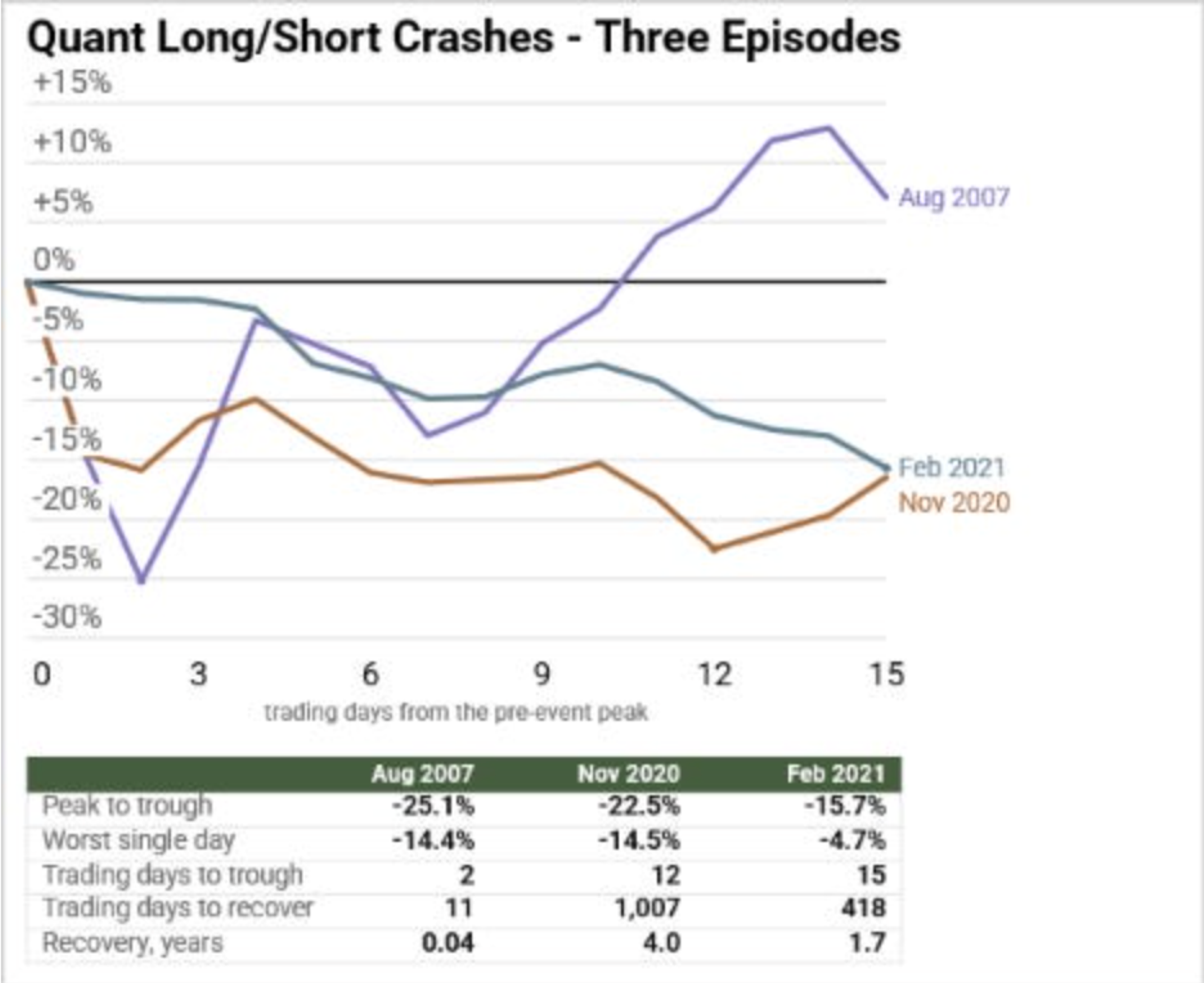
Given how much money has flooded into implementations of this strategy that are likely similar to each other, there are probably crowded positions lurking. Crowded positions carry asymmetric risk. If you have large managers that have to unwind their book - because leverage has made losses too large, or client redemptions, or any other of a host of reasons - then their trading can push the same positions further apart, causing cascading losses for everyone else. That was a big part of the story in the 2007 incident. It’s impossible to know how big of a risk that is today, but with so much money flying into the space so quickly, it is a little hard to believe it isn’t at least a modest concern.
We won’t say much of the benefits of these strategies, since that case is well made all over the Internet. And much of the benefits are real. For folks staring down the barrel of big realized gains elsewhere in their portfolio, these things can work great. Just size accordingly and be aware that things might not be as rosy as you hope.