Searching For D.B. Cooper
For those that don’t know the story of D.B. Cooper, you can read it here. The short version is the guy hijacked a plane in 1971, grabbed a big chunk of ransom money, then jumped out of the plane with a parachute into the middle of nowhere and vanished without a trace. He was never found, his real identity was never ascertained. To this day it remains an unsolved mystery, despite the best efforts of the FBI and a Reddit army.
In financial markets we don’t get many unsolved mysteries. Many, many things are surprising and confusing in the moment, but almost all of them can be unraveled in the post-mortem. There is too much data and transparency (at least to regulators) for big mysteries to persist. The Great Depression, the Tech Bubble, Black Friday, the GFC, all of these things were hard to predict but relatively easy to explain after the fact. We don’t have big head-scratchers from 50 years ago.
As I write this on the last day of May, I wonder if markets are in the midst of their D.B. Cooper event.
The closing of the Strait of Hormuz used to be a classic oil analyst thought experiment. How high would oil prices actually go? I’ll set the stage with a quote I enjoyed a few weeks back from Doomberg, a highly-regarded research shop with a specialty in energy:
"Had we been given the events of the past 75 days and asked to wager on front-month Brent crude at $150 per barrel, we would have greedily pledged our homes to take the over. While we wouldn’t be the first to be made homeless by the brutality of the markets, anybody who claims to have correctly predicted how oil prices would unfold is, well, almost certainly lying."
Normal stuff, in the sense that markets are surprising. So let’s do what we always do and look at what the data tells us is keeping the lid on prices. SPR releases? Sure that helps some. Demand destruction? Yeah, there is some, though even the highest credible estimates don’t get you anywhere close to bringing the market in balance. And then there is this chart:
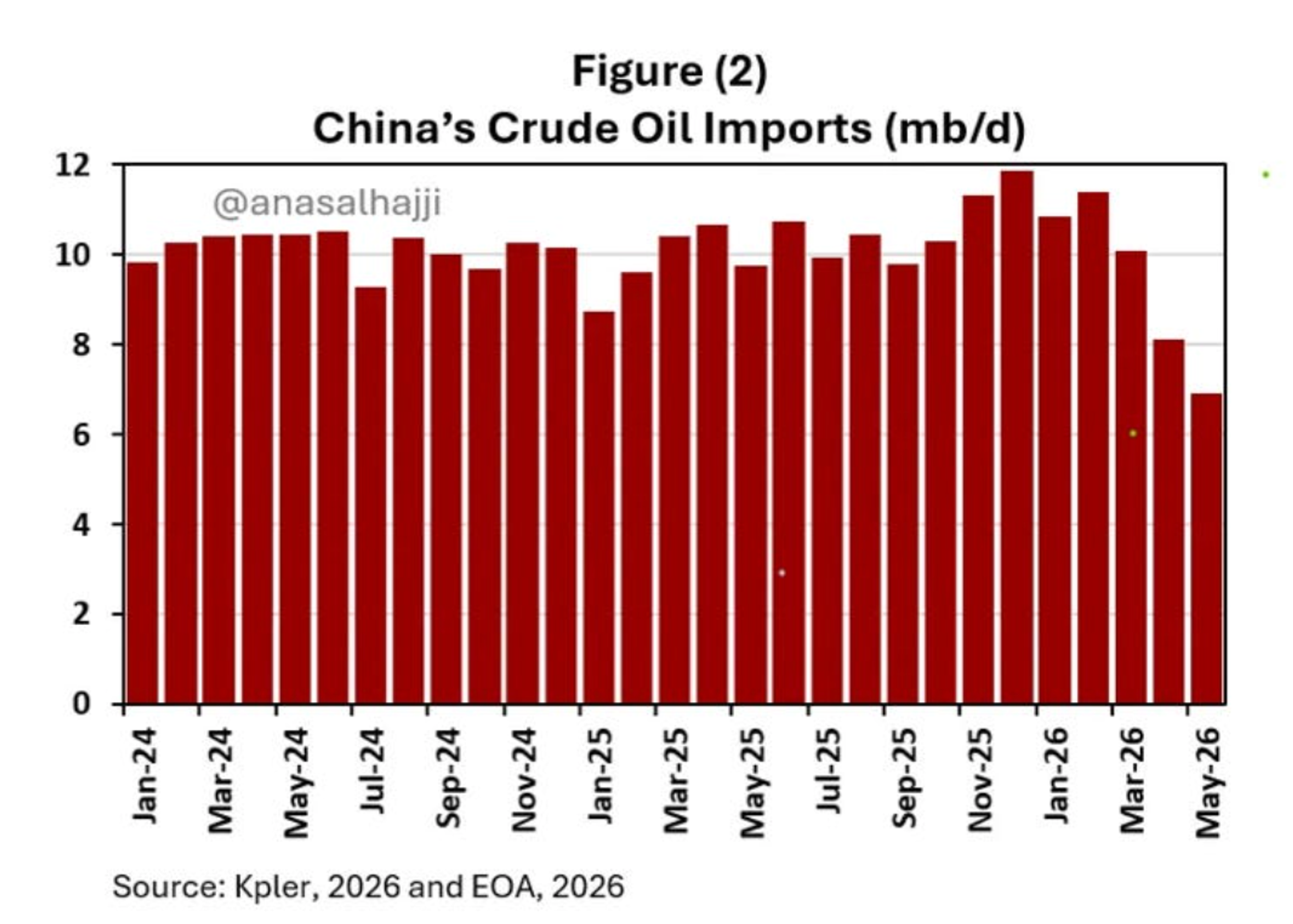
Whoa. Depending on where you want to draw the starting point, that’s a 3-4 million barrel a day drop in imports. To put that in perspective, that is as much oil as Germany, Spain, and Italy import…combined. All economic activity - and really all of modern civilization - is just the translation of energy from one form to another. That much missing energy should leave a mark. Let’s go back to the data.
Is the Chinese economy collapsing? No.
Have visible Chinese oil inventories been collapsing? They’ve fallen a bit lately, but on net they are up since the beginning of this conflict. So no.
Have they stopped exporting refined products (gasoline, jet fuel, diesel)? No.
Have they stopped manufacturing petrochemicals? No.
So how are they doing this? A lot of ink has been spilled by analysts with theories that are all over the map. But here’s the thing - many of those theories, if true, would be considered “state secrets” for the Chinese government. That means we may literally never know. It’ll be D.B. Cooper all over again.
While we have also been surprised by how long the status quo has been maintained, we continue to believe that the pressures are building for a resolution - one way or another. This has us paying a bit each day in option premium for a large payout if things radically shift in either direction. While we don’t have an edge in forecasting the results (or lack thereof) of the negotiation, we believe that markets are meaningfully underpricing the probability of big moves regardless of how the war proceeds.