Putting the Wind at Your Back
In my note last week I showed a table of 2025 global equity returns, with the US in 38th place. The point of that piece was to highlight that profits are not the same thing as equity returns, because how much you pay for those profits matters. But there is a second takeaway from that table - the impact of currency.
When you buy a foreign financial asset, you get two things - of course you get the financial asset’s return, but you also get the change in the exchange rate between your currency and theirs. For example, the Norwegian Krone (NOK) currently has an exchange rate of about 10:1 with the USD. If you take a dollar to Norway, you can trade it for 10 NOK, or vice versa. Now imagine you want to buy $100 USD of a Norwegian stock. You convert the $100 USD into 1000 NOK, and buy a single share of stock that has a price of 1000 NOK. Consider the following two cases:
- The price of the stock goes from 1000 NOK to 2000 NOK, and the USD/NOK exchange rate stays constant. Now you can sell your position for 2000 NOK, and convert it to $200 USD. You doubled your money.
- The price of the stock stays constant at 1000 NOK. But this time the USD weakens, and the exchange rate changes from 10:1 to 5:1. Now you sell the stock for 1000 NOK, and convert that to $200 USD. You again doubled your money, just in a different way.
The table below shows the change in exchange rates between the US and a sampling of countries in 2025. Positive numbers mean the USD got weaker against that currency. The USD fell against almost every currency in the world in 2025, which was a tailwind for Americans investing internationally.
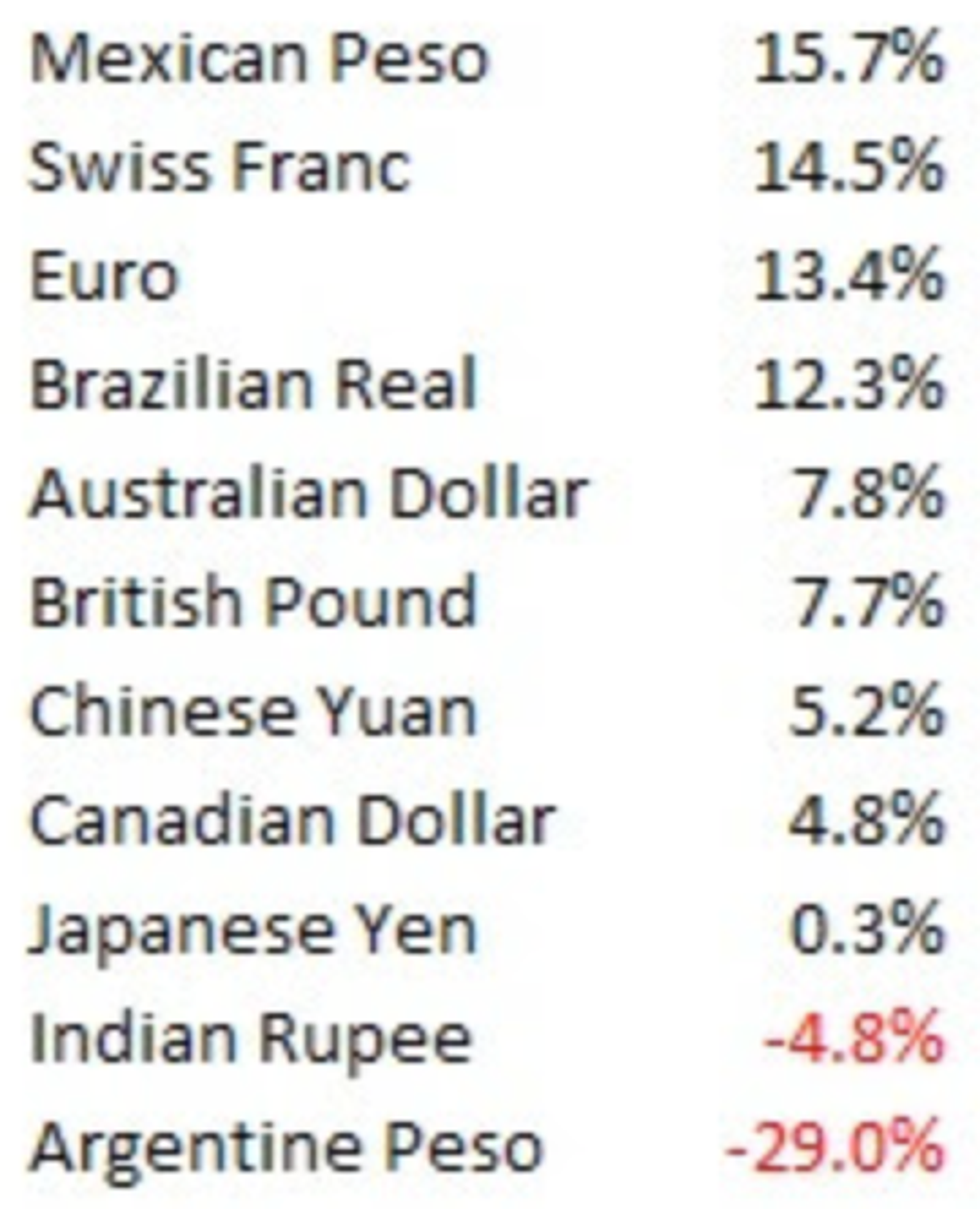
What does this mean for you? If you believe, like we do, that the USD is likely to weaken against global currencies over the medium to long run, you are giving yourself a tailwind by investing internationally. The long-term strategic portfolios that we build for clients are typically 60-70% outside of the US, in part for this reason.