Order the Diversification Salad
I’ve come to the realization that doctors and asset managers are kindred spirits. Doctors tell their patients “you should eat more vegetables and lose some weight” and are met with vigorous nodding. Then those same patients do what they actually want and hit Shake Shack for a Double Shack Burger and Campfire Smores Shake, which is definitely a random example and definitely not what I had for dinner last night.
Meanwhile asset managers like us tell people they should be diversified, and folks nod as they press the button to buy more NVDA. Their brain is on board with diversification but it’s not what their gut actually wants.
I am often reminded of a haunting conversation I had many years ago with a senior person at a large sovereign wealth fund. To paraphrase: “If we have 10 managers and 9 make money in a quarter, we celebrate. No one is concerned that all of our managers make (and presumably lose) money at the same time. Instead, the concern is for manager 10…why couldn’t they make money this quarter? Should we put them on a watch list?”
I find it fascinating how intuitively humans accept diversification in other parts of their life, just not with their money. A sports team is just a diversified portfolio of athletes who shine at different times. No one watches a soccer game and says “who’s that bum in the back with the colorful shirt, he hasn’t scored a goal all season.” Yet when bonds do poorly during economic booms, that’s pretty much exactly the reaction.
Making money feels good. It’s a dopamine hit that we want again and again. And because of that, most investors tend to overweight their personal experience of what has made and lost money versus considering the wider range of outcomes that history teaches us.
The table below is that history. I made it a while ago, so the numbers for the current decade have changed, but the point hasn’t changed. The assets that do the best and the worst are constantly changing. Asset class outperformance tends to make an asset expensive, which sows the seeds for poor future returns. The opposite is also true. Unloved assets get sold, which depresses their prices relative to the cash flows they produce and increases their future returns. The big takeaway is that unless you own a crystal ball you are usually better off owning a bunch of different stuff than gambling on one.
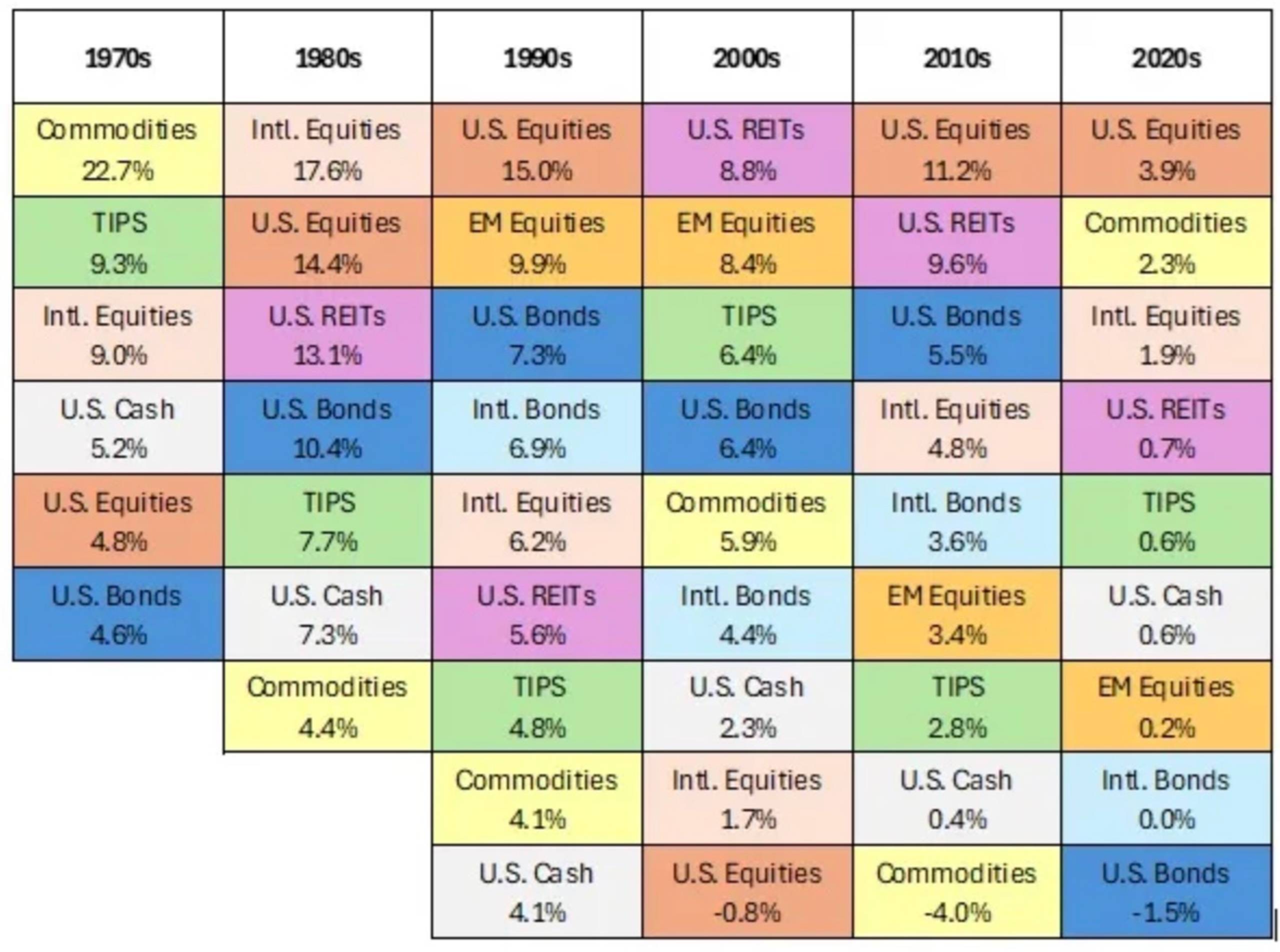
Source: Avos Analysis, Bloomberg, Dimensional. TIPS returns before 1997 are simulated by Avos.
Why am I saying this now? If you are ~40 years old or less, almost your entire adult life has been marked by the greatest bull run in a single market in all of financial history. Congrats! But now it is time to hold your nose, trust your brain over your gut, and take some chips off the US equity table. Not because some imminent crash is coming or something like that, but because it is always the right thing to do, and it is especially the right thing to do if you haven’t done it in a long time and your portfolio is concentrated in a small number of highly correlated stocks that just rallied a zillion percent.