Is the Gold Rally Over? Ask a Job Applicant.
There is a type of question that I associate with consulting interviews, where you are asked to do some order-of-magnitude back-of-the-envelope math. Questions like “how many golf balls are there in California” or “how many cheeseburgers can you fit in a school bus.” I guess they ask those questions because it is supposed to give insight into how the candidate thinks and solves problems? Or maybe they are just fun conversations for the interviewers? I don’t know, most hiring decisions strike me as just guesses, but that is another post.
For funsies, let’s apply some consultant tactics to a question that I get often: “is the rally in gold over?” Obviously nothing below resembles anything that happens in our actual investment process. It’s just a semi-reasonable way to figure out how many digits there are in a potential answer.
We’ll start with the following chart that FT published a few months back:
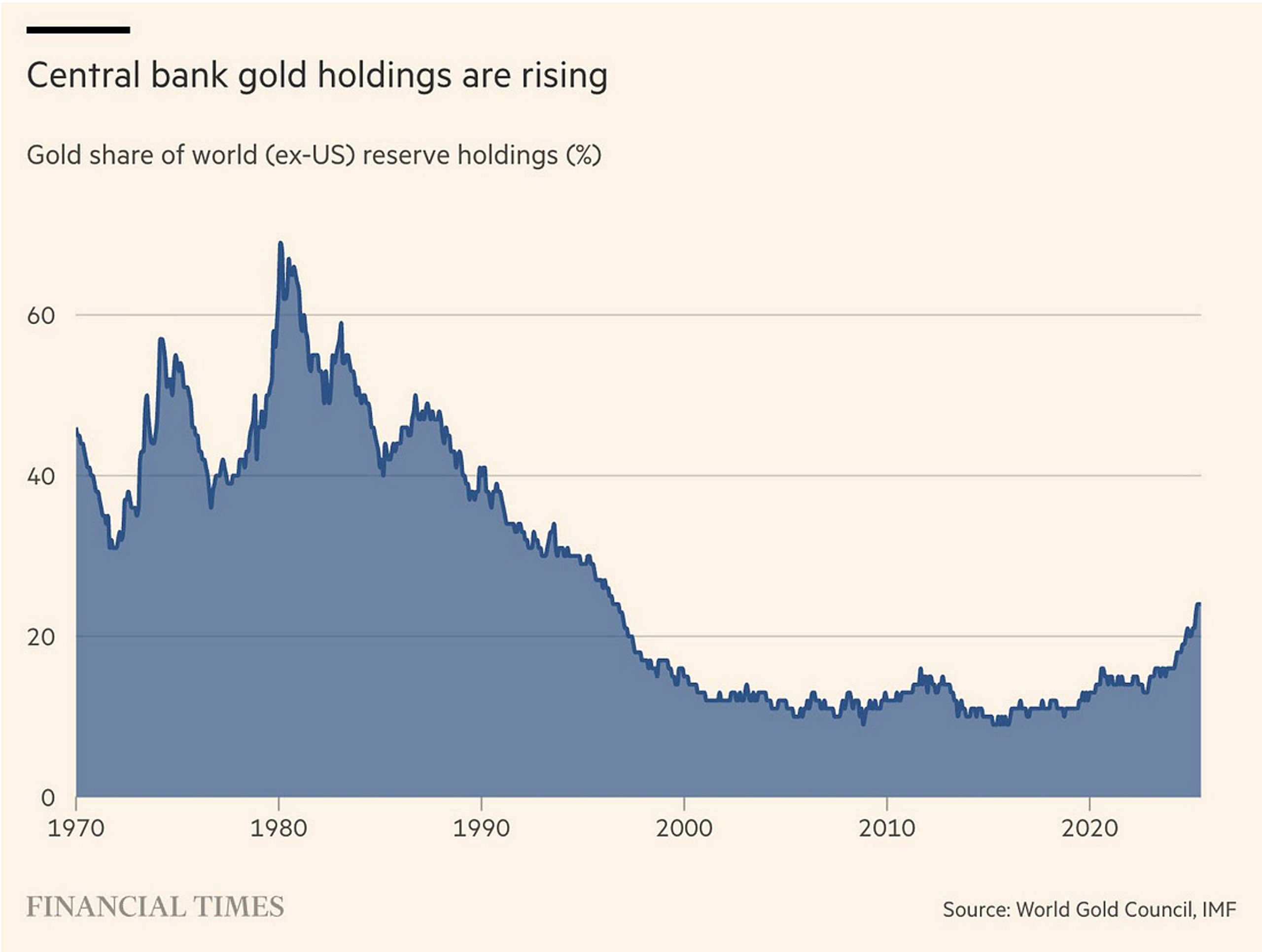
The recent buying spree (and price effect on their existing holdings) has taken central bank gold allocations back to where they were in the mid-to-late 1990’s. What if they wanted the level to match the late 1980’s? It’s not a huge mystery why foreign central banks are choosing to hold more of the wealth in an asset that isn’t someone else’s liability, so that seems eminently reasonable. Doing so would involve roughly doubling their gold holdings as a % of their reserve assets from here. Let’s do some consultant math to rough out what that implies for the returns.
Method 1: Global central banks have added that much to their reserves twice before, in the early and late 1970s. The chart below shows the rolling 3-yr return of gold. You can see that previous buying sprees have corresponded with rallies that are 2.5-3x the current one.
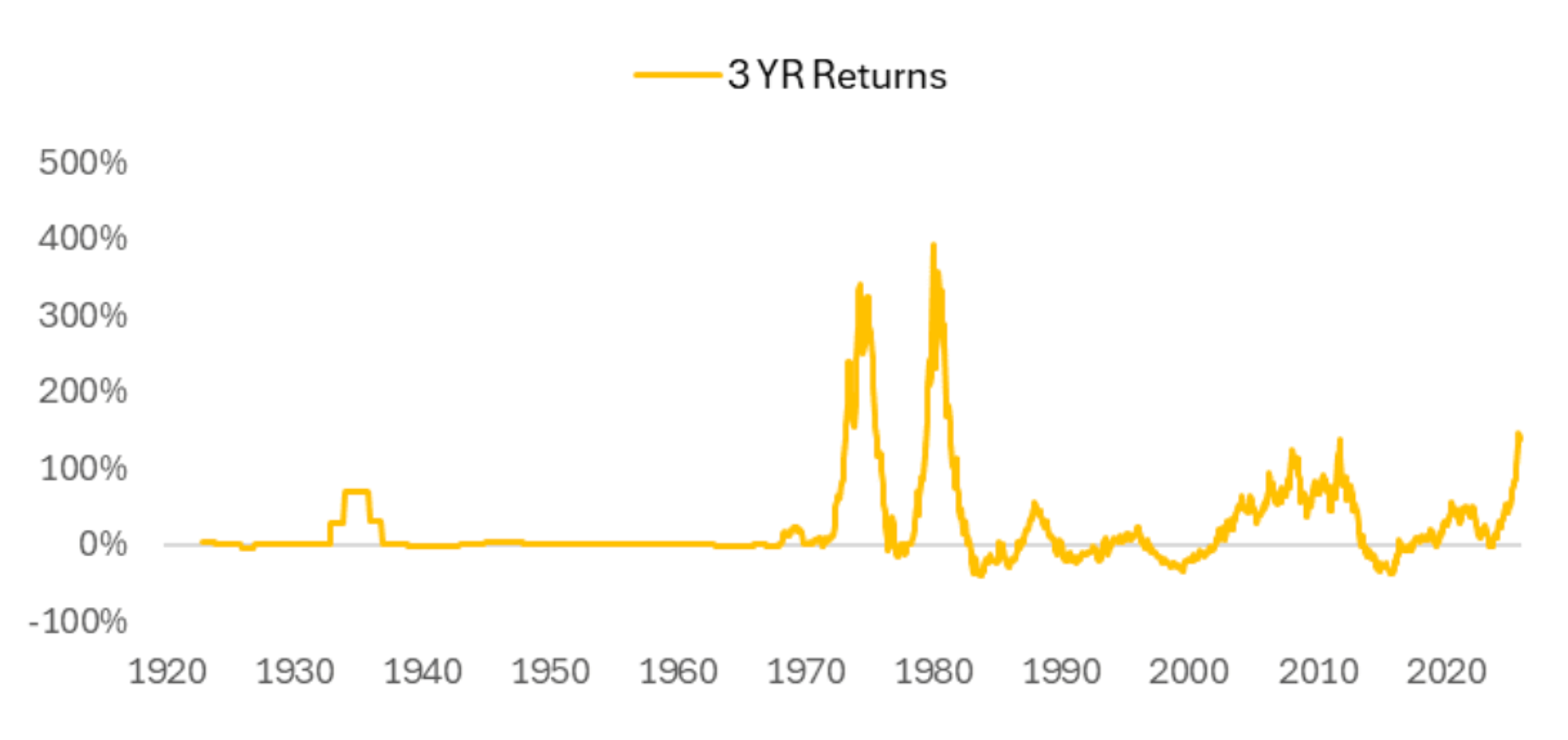
Method 2: Central banks added about 10% to their holdings over the last 3 years, and the price doubled. If they wanted to get back to their gold allocation from circa 1990, they would have to add 10% twice more. So doubling twice is a 4x return.
I just want to reiterate what I said at the top - nothing like this is actually in our investment process. But it directionally agrees with what our investment process produces as a synthesis: if central banks keep acting like they have been, and we believe they will, more of the gold rally is in front of us than behind us.