Is NVDA Cheap?
I didn’t write last weekend because I was in Las Vegas for my birthday. Maybe that was a missed opportunity - what better place to write about Jensen Huang than the infidelity capital of the world?
I enjoy going to Vegas a couple of times a year - I like to play poker, I like a good show, and I like a nice steak. And given my choice of career, I also can’t help but respect the investing prowess of the casinos. Their business is creating a small, repeatable edge and then diversifying it across millions of small bets so that they basically can’t lose. Tables have maximum bet sizes to prevent meaningful losses if they get unlucky. If you ran your 401k like MGM runs the Bellagio, you’d be set for life.
Very few people operate that way. And partially for that reason, I’ve gotten a lot of questions in the last few days about whether some individual stocks are cheap now, since they are down 50% (NVDA), or 60% (ORCL), or 70% (CRWV), or even 80% (IREN). The answer is that it is unknowable, by you, by me, and by 99.99999% of the investing world. Just because a stock fell a lot doesn’t make it cheap. IREN had an NVDA-sized fall, and then from there had an ORCL-sized fall. The reverse is true, too. If Delmonico in Las Vegas doubled the price of their Banana Cream Pie, it would still be an incredibly good value.
What is more knowable is the attractiveness of country-level indices. Indices diversify away a lot of the idiosyncratic Chinese honeypot risk, and connect more directly to the condition of the macro economy. Given the level of pricing, we have expected the US to be one of the worst performing equity markets in the world for a while, and over the last two years that has been true.
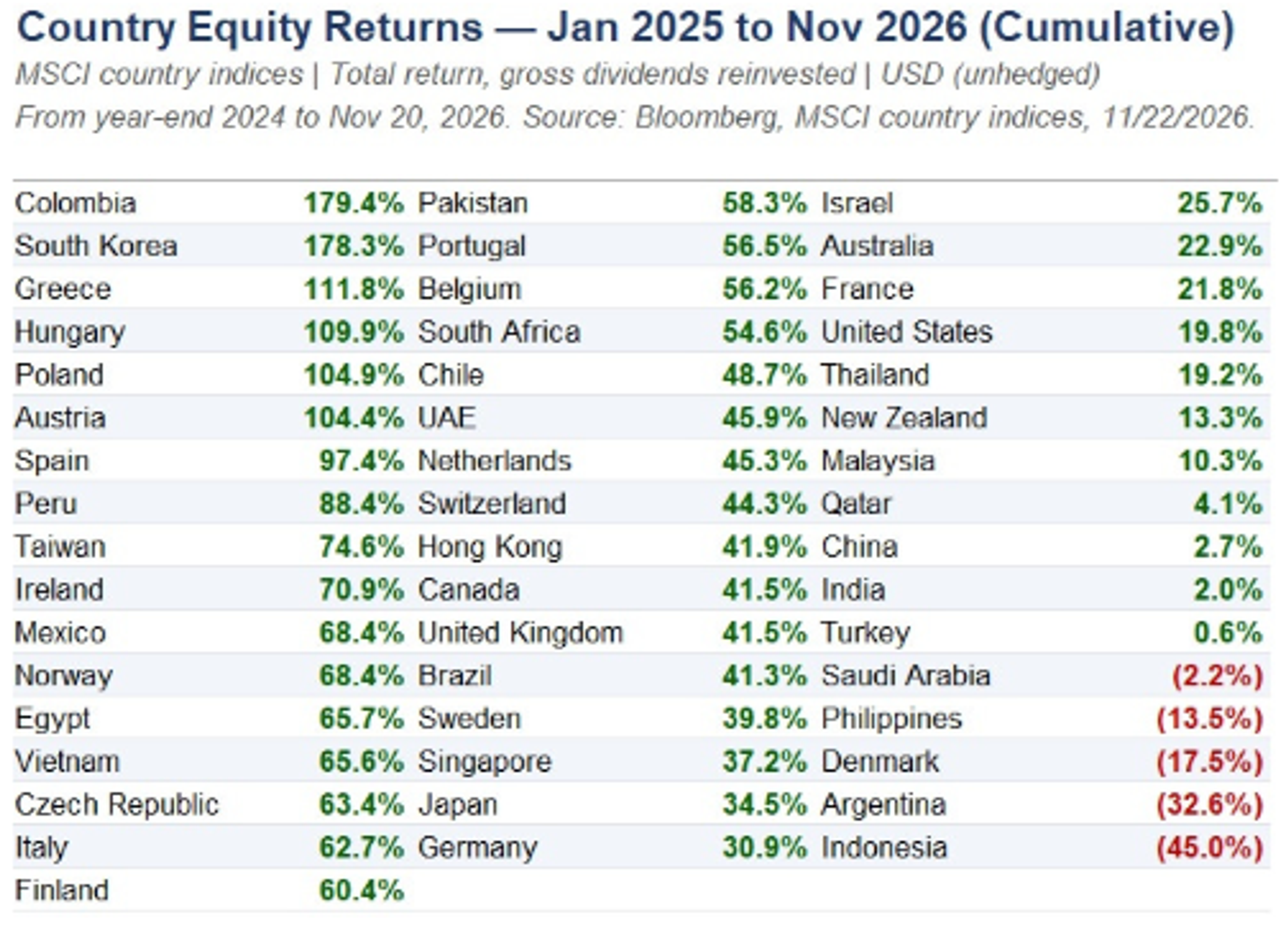
So what about from here? Our equity process is spitting out that the US stock market is now the 28th most attractive global equity market, and still less attractive than ~80% of it’s own history. Nothing to write home about. The recent losses, which look large up close, have barely dented our views…and we are positioned accordingly.
Letters like this always have a disclaimer about how this isn’t investment advice. My articles often talk about literal trades we have on, but they aren’t investment advice. My real investment advice is don’t just do a trade because some dude on Substack likes it, do your own research.