Is Buying ETFs Like Buying Groceries?
One debatable question is how involved the government should be in our day-to-day life. On one end of the spectrum you have proponents of a “nanny state” where the government acts like an overbearing parent. At the other end, you’ve got folks who believe the government should barely exist at all. It’s not exactly a hot take to say that my answer lies somewhere between those two extremes. But my recent experience launching an ETF has given me cause to think about this question.
We have different expectations for the safety of different products. If you go to a grocery store, you aren’t thinking about “caveat emptor.” The store isn’t selling bread with arsenic as an ingredient, if its on the shelf you can assume it is safe. The worst thing that could happen is that you could get a tummy ache from buying and eating too many Hot Pockets.
Home Depot operates at a different point on the spectrum. They sell a lot of stuff that is super dangerous if used poorly, but also super useful in the hands of a professional. I have a tree branch that is hanging alarmingly close to the line that brings power to my house. If I wanted, I could go into Home Depot right now and buy a gigantic ladder and a chainsaw. The government isn’t going to stop me, what stops me is fear of maiming myself and going viral on Tik Tok when my neighbor posts the video “Idiot with chainsaw falls off ladder.” Eventually I’ll call a professional and they will use those same tools and take care of the problem without a hitch.
You could imagine more extreme examples. I can’t go on Amazon and buy enriched uranium or a bazooka. The government has said “there are no legitimate uses for these things, they are illegal.” Reasonable!
Which brings us to financial products. Where are they on this spectrum?
When we decided to use the ticker AVOS for our ETF, we checked to see if it was already being used on other exchanges. It is - there is a product on the London Stock Exchange with the ticker AVOS. What does it do? It gives you a 3x levered short position in Broadcom. I have to ask - what legitimate use is there for this product? I don’t need it - if I lose my marbles and decide to go 3x short Broadcom, I can easily do that myself without paying their exorbitant fees. It is targeting precisely 1) people who aren’t sophisticated enough to do a relatively simple thing themselves with 2) a fund that is ultra risky and has no reasonable legitimate uses. Folks who buy this fund are either going to get lucky or get hurt. So I didn’t worry too much about “confusion” between this fund and ours, since their fund is obviously going to blow up and disappear before too long.
This week we had the pleasure of visiting the Nasdaq building in NYC to celebrate our listing. It’s weird that the camera only added 10 pounds to me and not everyone else.
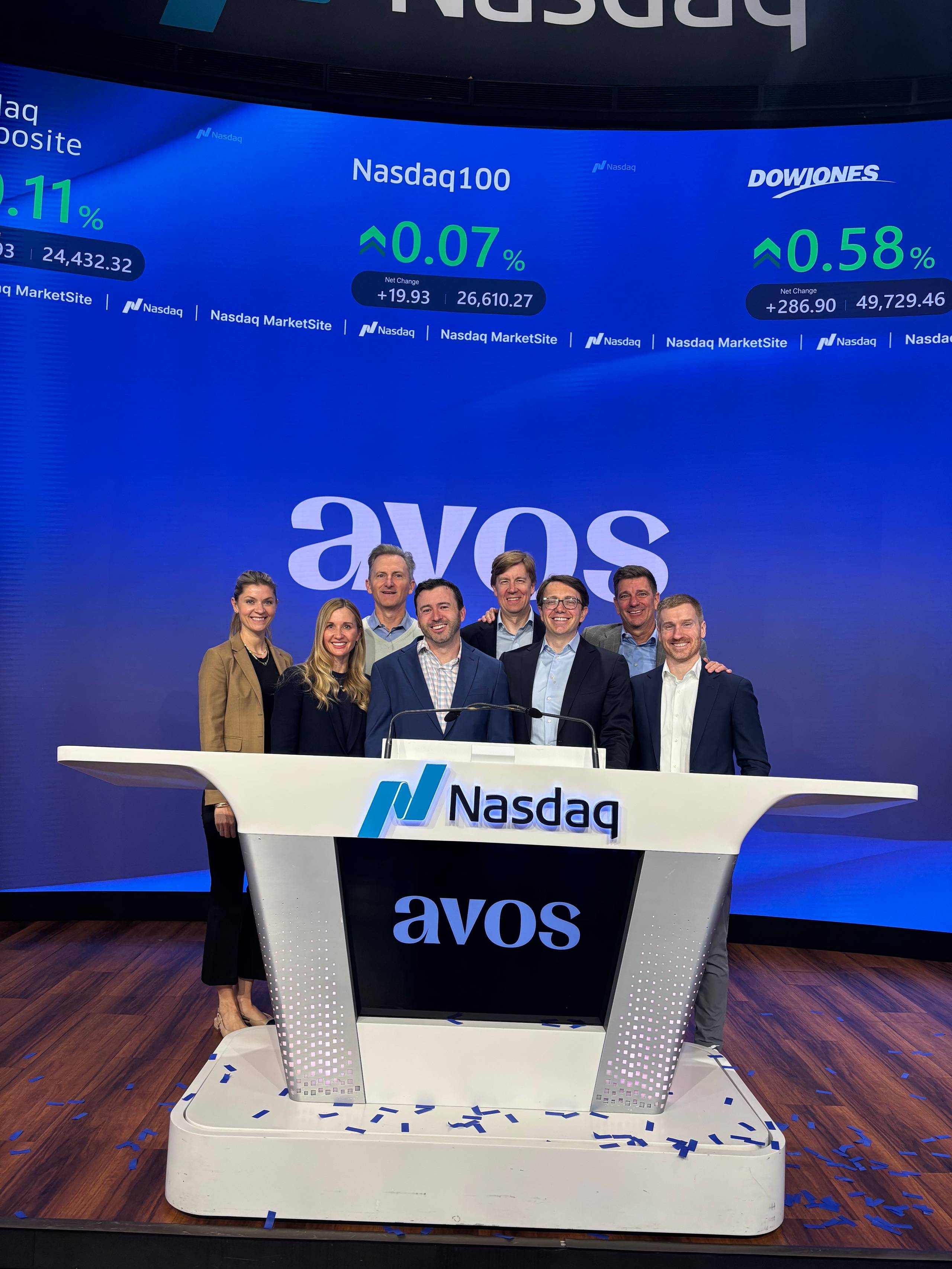
During our visit, we saw a big firm ring the opening bell for their ETF launch. This beauty was described as a “Nasdaq Dynamic Buffered High Income Index ETF.” Or, to translate, the Nasdaq index return but lower, with more fees, and with worse tax treatment. I ask again - what legitimate use is there for this product?
So to answer the question posed by the title of this piece: no, buying ETFs is absolutely not like buying groceries. An alarming number of ETFs are, objectively speaking, bread made out of arsenic. Now we are also getting an expansion of crypto and private asset products that are available to the masses, and again, a lot are pure arsenic. So to the extent this piece has actual advice and isn’t just an old man yelling at the clouds, I’d give the following 1) anytime you hear the word “democratization” around a financial product, you should probably run away 2) if you yourself can’t tell the difference between products with a legitimate role in a portfolio and radioactive gambling, find someone who can to help you 3) if the person or company creating the product is not buying it with their own money, you shouldn’t either.