Buying lemonade stands in Detroit
When I worked at Bridgewater, I would sometimes be tasked with schlepping up to Harvard Business School to help interview candidates. Dozens of these interviews started with the exact same volley:
Me: "Why do equities make money in the long run?"
Them: "Economic growth"
Me: "Is it possible for equities to make money if there is no growth?"
Them: "No"
At this point I would wheel out the example of a lemonade stand in Detroit. The business model was simple - buy lemonade at the store for a dime and sell it on the street corner for a quarter. Margins were fixed. Unfortunately, since Detroit was shrinking (this was 15 years ago! times have changed!), this lemonade stand was going to sell fewer and fewer glasses of lemonade every year. Maybe 1000 in year one, 950 in year two, and so on. So the next question I would ask is, "would you buy part of this business?"
This is where the interview would diverge into pretty much all imaginable and unimaginable paths. But the savvy candidates realized that the only answer was "depends on the price." If you pay very little for this business, it can generate a great return. And conversely, if you pay a crazy amount for a great, growing business, your long-term return will be disappointing. In other words, the long-term return of investing in equities doesn't come from how fast the companies grow, it comes from how fast they grow relative to what you paid for them.
A google search will reveal many charts, graphs, and tables like the below. This was from a research piece that Northern Trust put out a few years ago, where they used a 20 year sample comparing real GDP growth vs real equity returns across the 46 countries in the MSCI All Country World Index. There is no relationship between the growth rate of an economy and the return of their equity market, because growth isn't what matters, it is growth relative to what you paid for it.
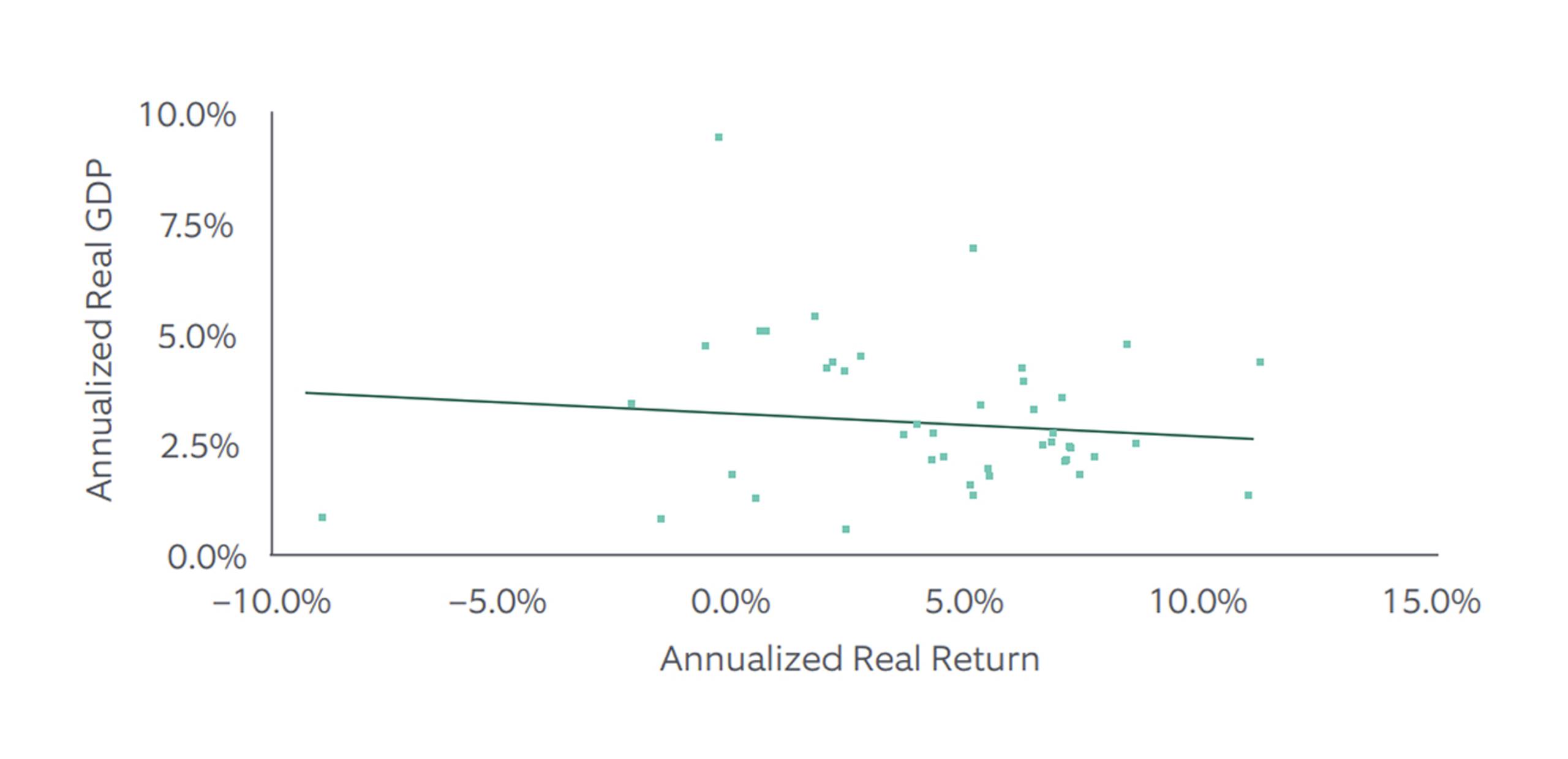
No Link Between GDP Growth and Equity Returns
feels better to wildly overpay for good companies than it does to pay discount prices for boring and or/mediocre businesses. Even if they intellectually agree with everything I've said above, most of them can't pull the trigger and literally do the trades. That behavior is part of what creates the opportunity on offer in the world today. To be specific, we believe the investors who hold their noses and diversify their US equity holdings into cheaper global equities are setting themselves up for a decade of outperformance relative to those who stand pat.