But What Have You Done For Me Lately?
Imagine you're a pension fund consultant, and someone walks into your office and says: "I've found an investment with a 155-year track record that has paid investors about as well as stocks, but makes money at different times, and is especially good in the years when stocks get crushed." You would be extremely interested! Your mind would immediately go to all of the white papers you could write and conference talks you could give. And then they tell you it's commodity futures and you say "never mind" and go back to arguing about how much to allocate to private credit.
The benefits of commodities have felt very theoretical for most of our investing lifetimes, shaped instead by living through the biggest equity bull market of all time. This has created the prevailing wisdom that commodities are an anchor around your neck, underperforming financial assets like stocks and bonds and therefore not worth including. The average institutional allocation to commodities is less than 1%, with a lot of zeroes in the sample.
But is the premise right? Are commodities an anchor around your neck? We now have some new data to help us wrestle with that question. In a recently published academic paper with the pragmatic title “An Index of Commodity Futures Returns Since 1871,” the authors do the horrific grunt work of slogging through primary sources back to the Ulysses S. Grant administration to reconstruct commodity returns. This gives us the ability to compare them apples-to-apples to other asset classes. The paper includes many interesting nuggets but perhaps the most relevant is that commodities outperformed equities in 43% of years and 40% of decades. Hardly an anchor! Here’s the chart:
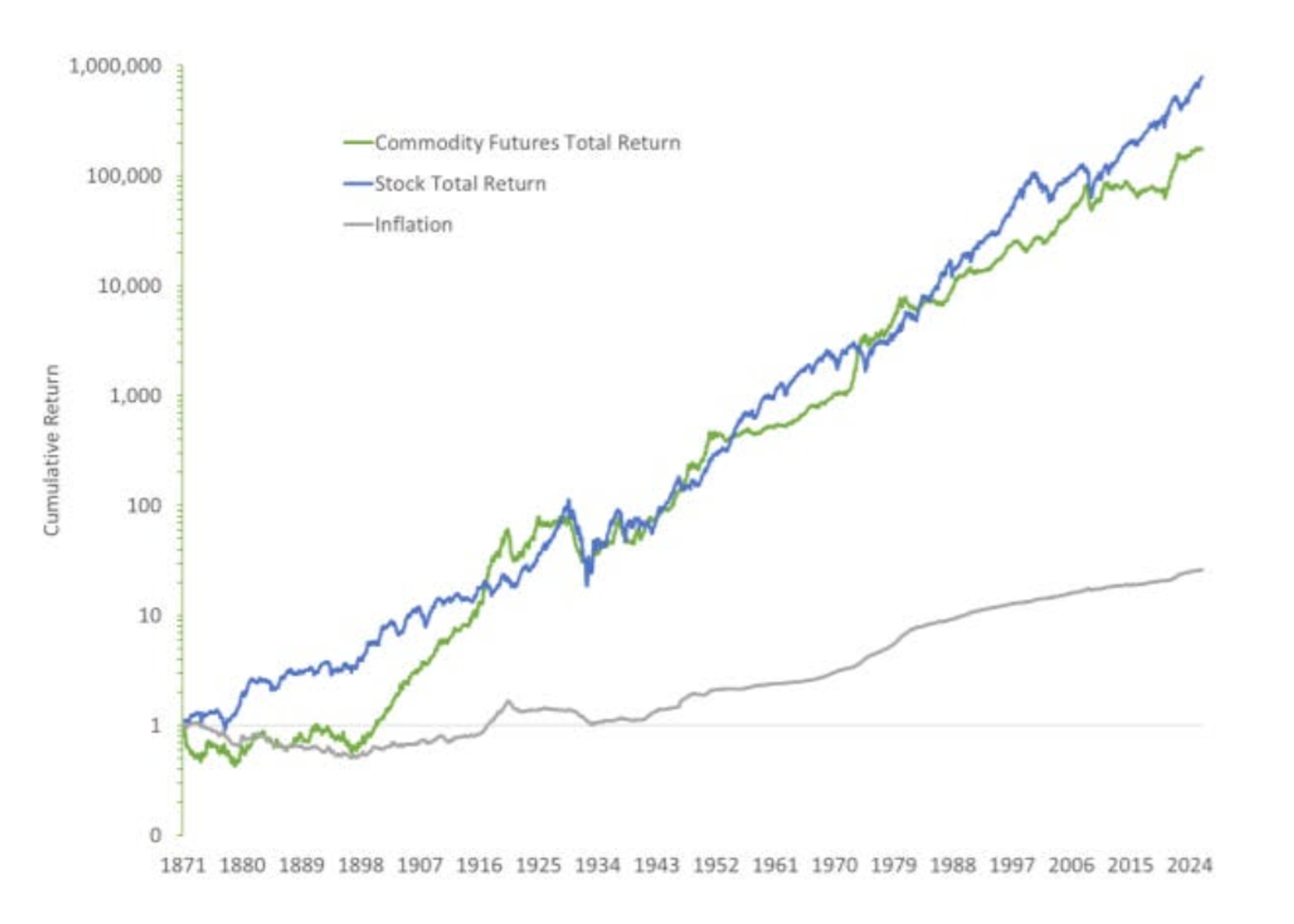
Commodities and equities basically battled to a tie in the first 135 years of the sample, before equities ripped ahead post-GFC. As the chart shows, that has happened a few other times in history, and every time the real assets reeled in the financial ones. Do with that information what you will. For us, a healthy slug of commodities always made conceptual sense for a portfolio; now it makes empirical sense too.
For those that are interested in the details, the paper is here.