Bad Takes, Big Risks
We don't normally want to spend our time criticizing the bad investment ideas making the rounds. There's always a lot of bad ideas out there, so we think it's better to simply tell you what our best thinking is on the important subjects rather than react to every random tweet. But now feels different; this is a time where investors are (quite understandably) primed to react, which means the really bad thinking that's out there is more likely to do damage. In this note we want to dispel some of the most dangerous bad ideas we're hearing in the financial press and describe what we would do instead. As always, if you have follow up questions or want to discuss any of this, let us know.
Bad Take #1: If deals are negotiated and tariffs are rolled back, markets will go back to the way they were.
Even with the most charitable assumption that more or less everything will be walked back, there is massive damage that is already done. Foreigners have already demonstrated that their attitudes towards the US and US investments have shifted - from small things like booing our national anthem at sporting events, to medium things like a sudden collapse in tourism to the US, to larger things like visible capital flight. Diminished trust is not easily rebuilt. Foreign selling was likely an important culprit behind the worst bond market selloff in decades this week. And in the equity market foreign selling has contributed to the chaos, as illustrated below.
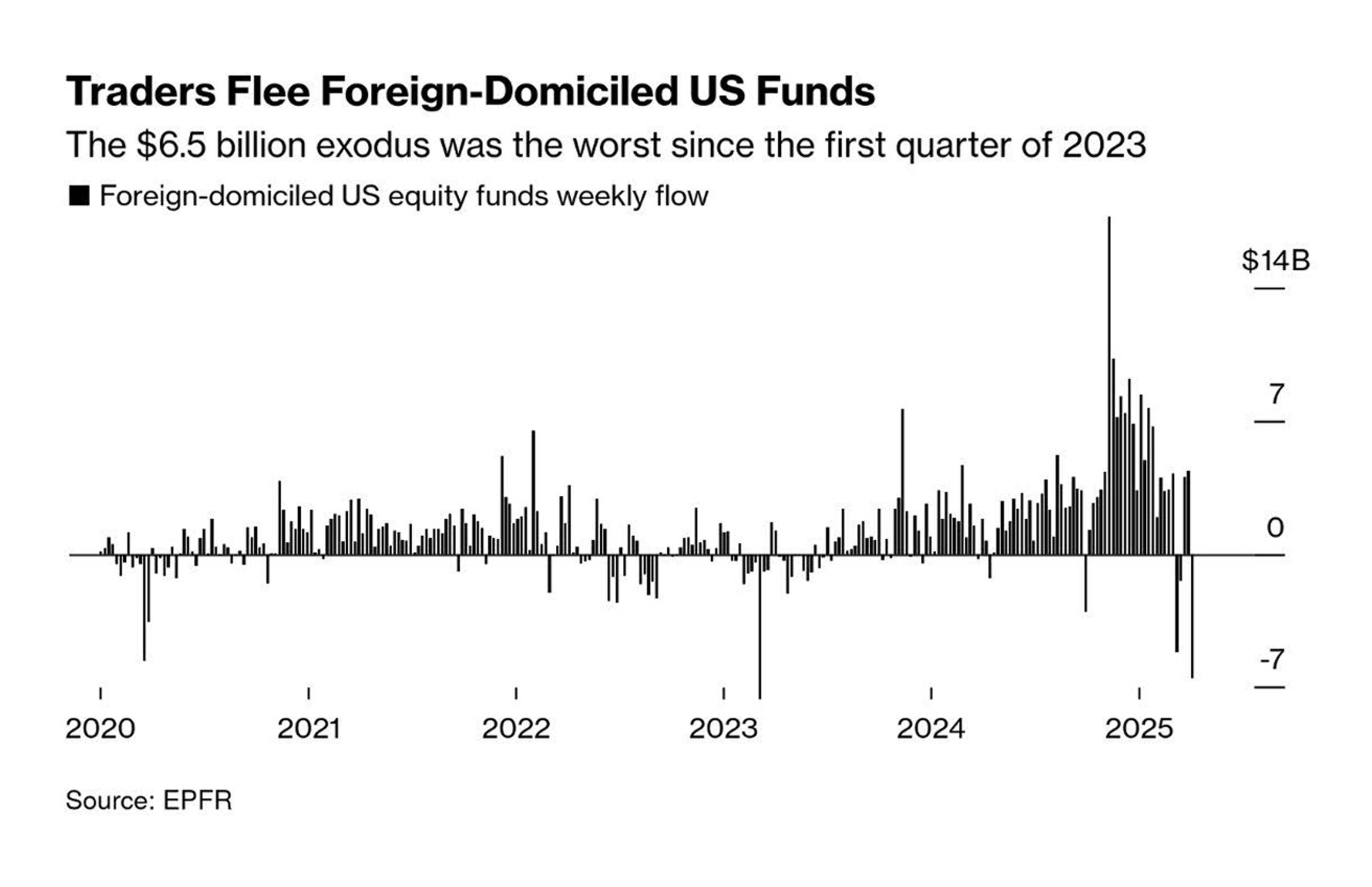
Trader Flee Foreign-Domiciled US Funds
Note the scale on that chart - a $7 billion outflow from equities. Foreigners own $17 trillion. Is it so hard to imagine that instead of a 70% allocation to US equities (the US weight in the MSCI index) they might think a 60% weight is more appropriate? That would be over $2 trillion to sell. In total, foreigners own $32 trillion of securities across equities and fixed income. That means for every 1% change in their desired allocation to the US, you get another $320 billion in selling. That is truly massive.
My big point here is that the price of all US assets - stocks, bonds, and the dollar itself - is propped up by the heavy demand of foreigners. If that weakens even a tiny amount, the prices of all three need a large reset. And the evidence points to it having weakened. Of course there is no guarantee that the capital flight from the US will continue and/or intensify, but the probabilities have shifted and the risks are large and asymmetric. There is no reason to gamble.
Investment Implication: Be globally diversified before foreigners diversify. Then you will be positioned to benefit from the change in the relative pricing of global assets, instead of being hurt by it.
Bad Take #2: Since the dollar is the global reserve currency and the currency of global trade, it can't have a crisis.
If we were talking about any other currency, the recent market action - stocks, bonds, and USD all down, gold up a lot - would scream "currency crisis." Luckily there is a unique floor on demand for USD because of the need for dollars to facilitate global trade, so there is probably almost no chance of a total collapse of the USD in the way that many other countries with currency breakdowns have experienced. But that doesn't mean the USD couldn't have a chunky, painful selloff. If foreigners continue to sell US assets, what can the Fed do? They can print USD to buy bonds and cap the yield on Treasuries. They can print USD and put a floor under US equities by buying them. But as it relates to the USD itself, they can't do anything if they are also fighting the bond and equity markets, and in fact all that money printing just exacerbates the currency weakness. To fight currency outflows they would need to raise interest rates meaningfully and in doing so crush the domestic economy, which they are very, very unlikely to do.
Investment Implication: For most investors - at least the ones who are getting this email - there is no reason to denominate all of your wealth in USD and take the chance that the USD will be meaningfully devalued. The easy way to do this is to leave the currency exposure from foreign stocks and bonds when you diversify globally (don't hedge).
Bad Take #3: Bitcoin is digital gold and can be used as a replacement for gold in a portfolio.
There is no substitute for gold in a true crisis. And a crisis is not the time for untested academic or theoretical arguments about relative scarcity.
If there is a dollar crisis, it will be because foreigners are selling down USD assets and storing their wealth in a different way. Most large foreign institutions - central banks and sovereign wealth funds - use gold as their primary non-USD store of wealth. In other words, the existence of the crisis creates a mechanical flow of money into gold. Meanwhile, the folks who own bitcoin also own the assets getting sold - mostly US stocks. They will be taking pain elsewhere in their portfolio and in many cases running into margin calls/forced liquidations. Maybe there will be a groundswell of new flows into Bitcoin in the case where the stock market is melting down, but that doesn't make sense to me conceptually or empirically and I really can't see any argument that it makes sense to take that gamble.
Investment Implication: You should have at least 10% gold in your portfolio, and if it continues to rally you shouldn't rebalance away from it.